Manage employee bank accounts
Each employee needs at least one bank account on file so Paysense can generate payment files for their wages. When an employee has a single account, the entire net pay is deposited there. When they have multiple accounts, you use payment allocation rules to control how wages are split.
This guide covers adding bank accounts and configuring the five allocation types.
What you'll need
| Item | Required | Notes |
|---|---|---|
| An employee already added in Paysense | Yes | See Add an employee if you haven't done this yet |
| The employee's bank account details | Yes | Account name, account number, and BSB for each account |
Step 1: Open the employee's Banking page
From the left-hand sidebar, expand the employee's name and click Banking. You'll see the Employee Bank Accounts page listing any existing accounts.
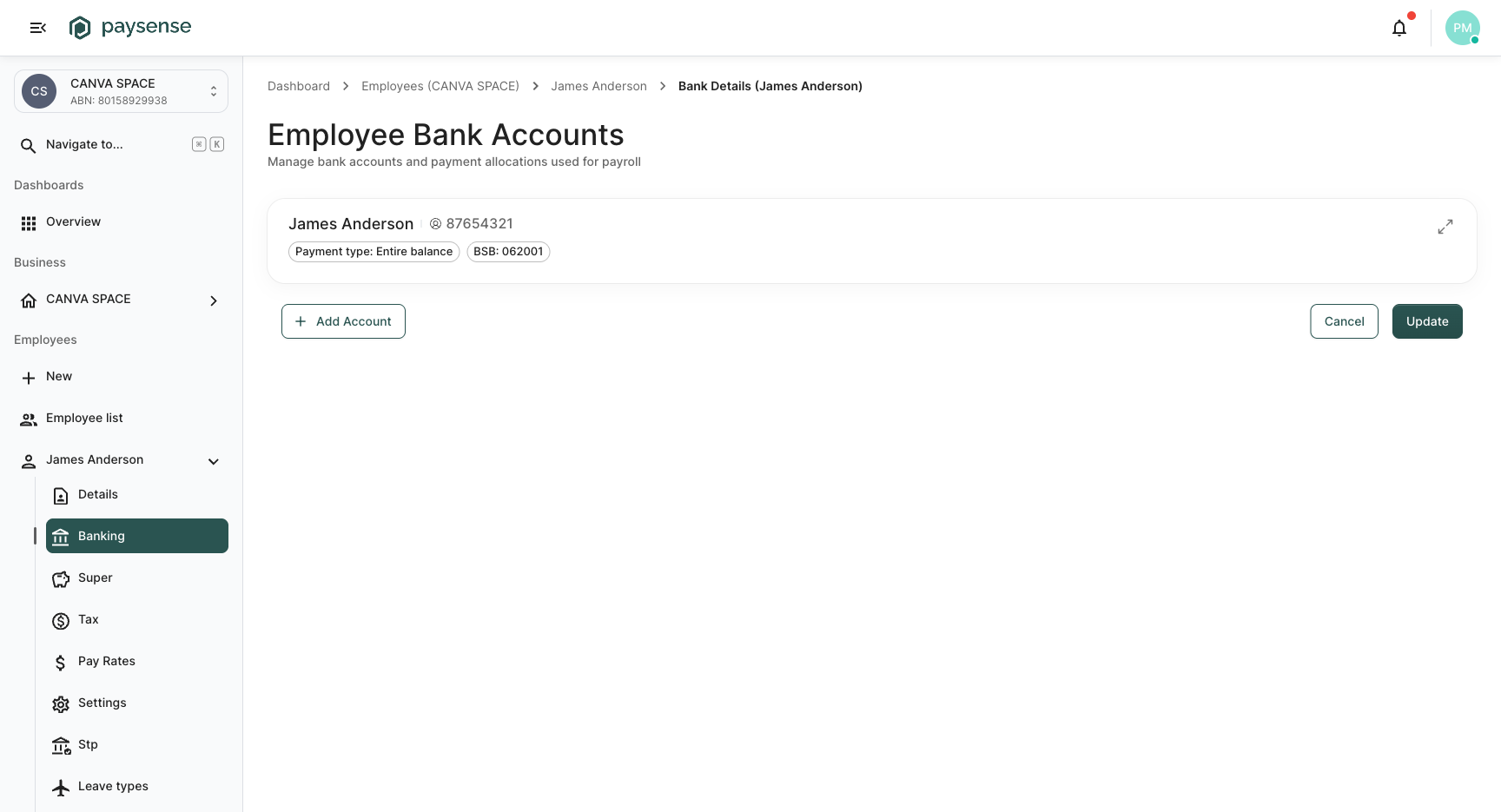
Each account card shows the account name, account number, payment type, and BSB at a glance. Click the expand icon on a card to view and edit the full details.
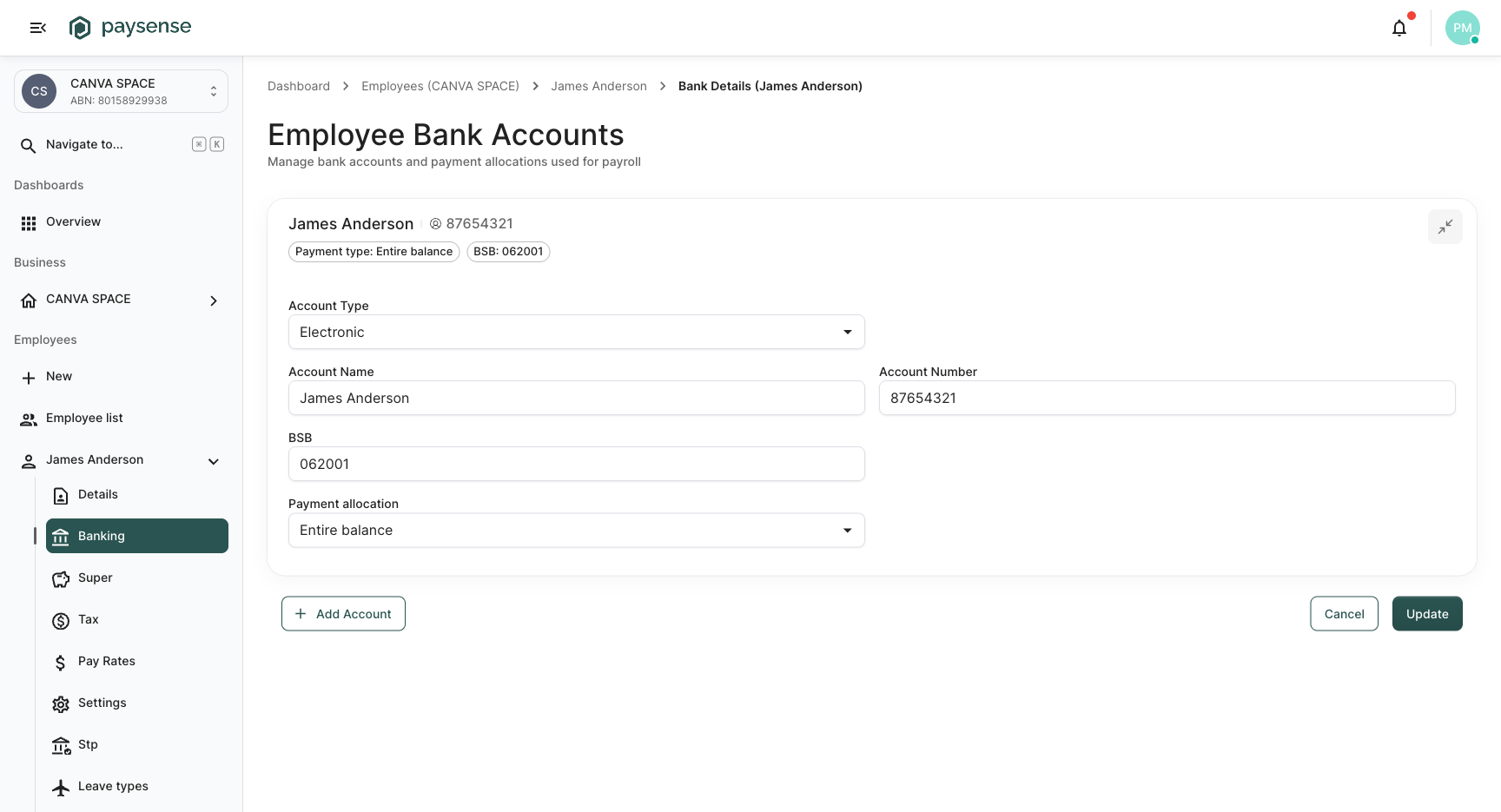
| Field | Required | Notes |
|---|---|---|
| Account Type | Yes | Electronic for standard bank transfers, or Cash for cash payments |
| Account Name | Yes | The name on the bank account |
| Account Number | Yes | The bank account number |
| BSB | Yes | The six-digit Bank State Branch code |
| Payment allocation | Yes | Controls how wages are distributed to this account: see below |
Step 2: Understand payment allocation types
The Payment allocation dropdown determines how the employee's net pay is distributed to each account. The available options depend on how many accounts the employee has and what other accounts are already configured.
| Allocation type | When to use it | Additional field |
|---|---|---|
| Entire balance | The employee has a single bank account: all net pay goes here | None |
| Fixed amount | A specific dollar amount should go to this account each pay (e.g. $500 to a savings account) | Fixed amount ($) |
| Percentage | A percentage of net pay should go to this account (e.g. 20% to a savings account) | Percentage (%) |
| Remaining balance | This account receives whatever is left after all fixed and percentage allocations | None |
| Manual | The amount is not calculated automatically: you specify it manually each pay run | None |
How allocation types work together
When an employee has a single account, the allocation is automatically set to Entire balance: the full net pay goes to that account.
When you add a second account, the first account's allocation automatically switches to Remaining balance, and you choose how the second account is allocated. This is the most common split pattern:
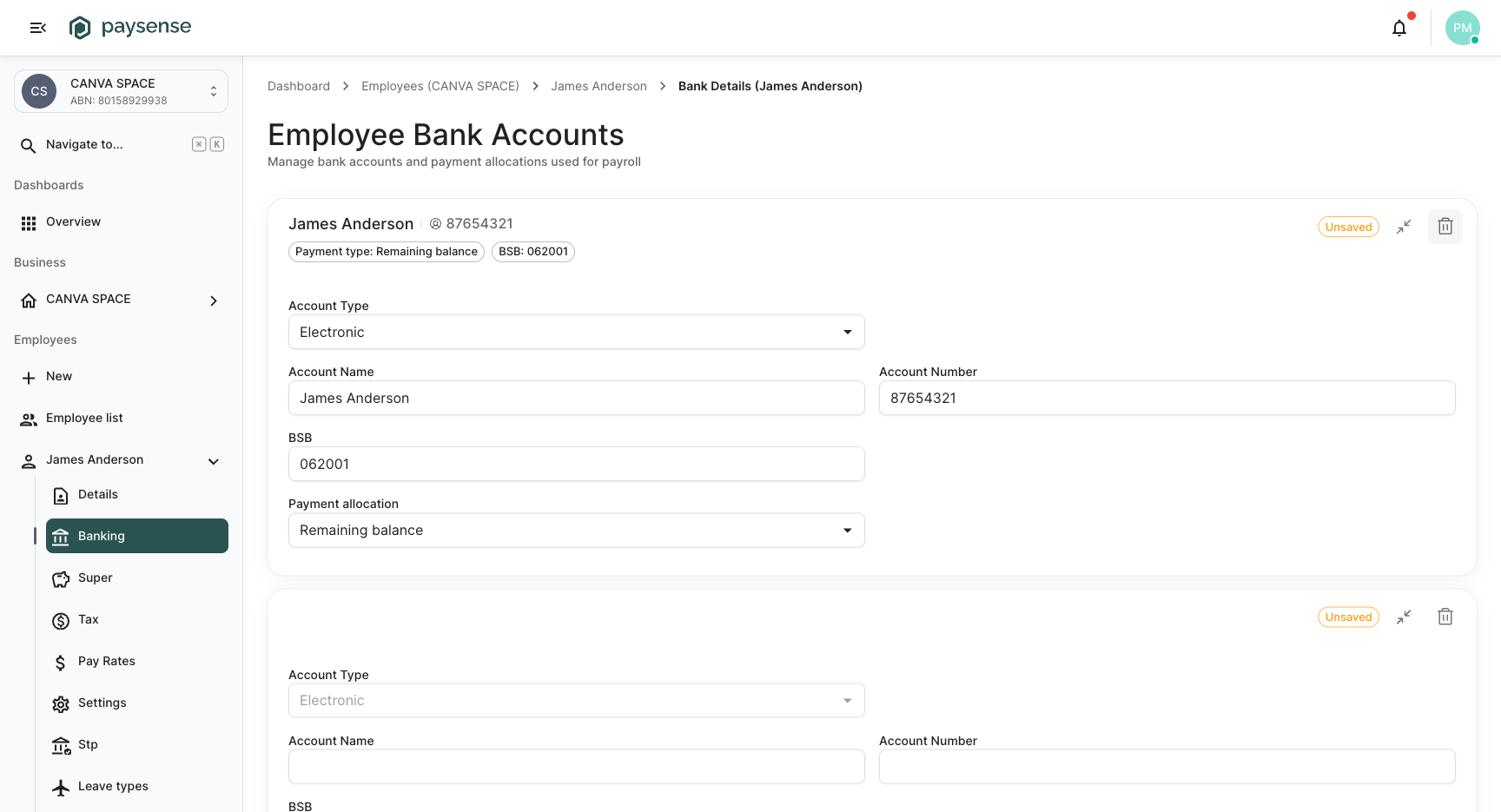
The payment allocation dropdown shows which types are available. Greyed-out options cannot be selected because another account already fills that role:
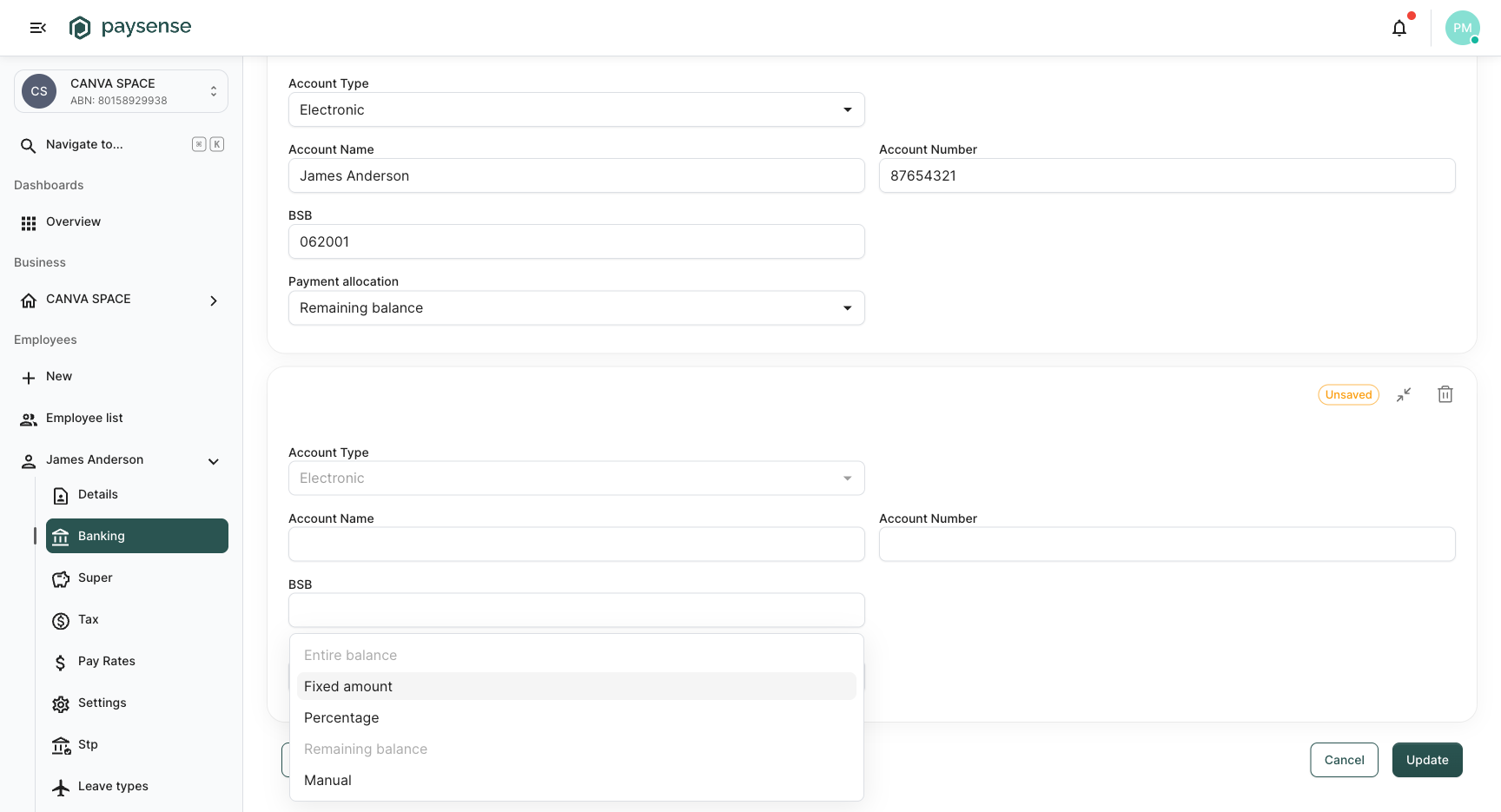
When you select Fixed amount, an additional field appears where you enter the dollar amount:
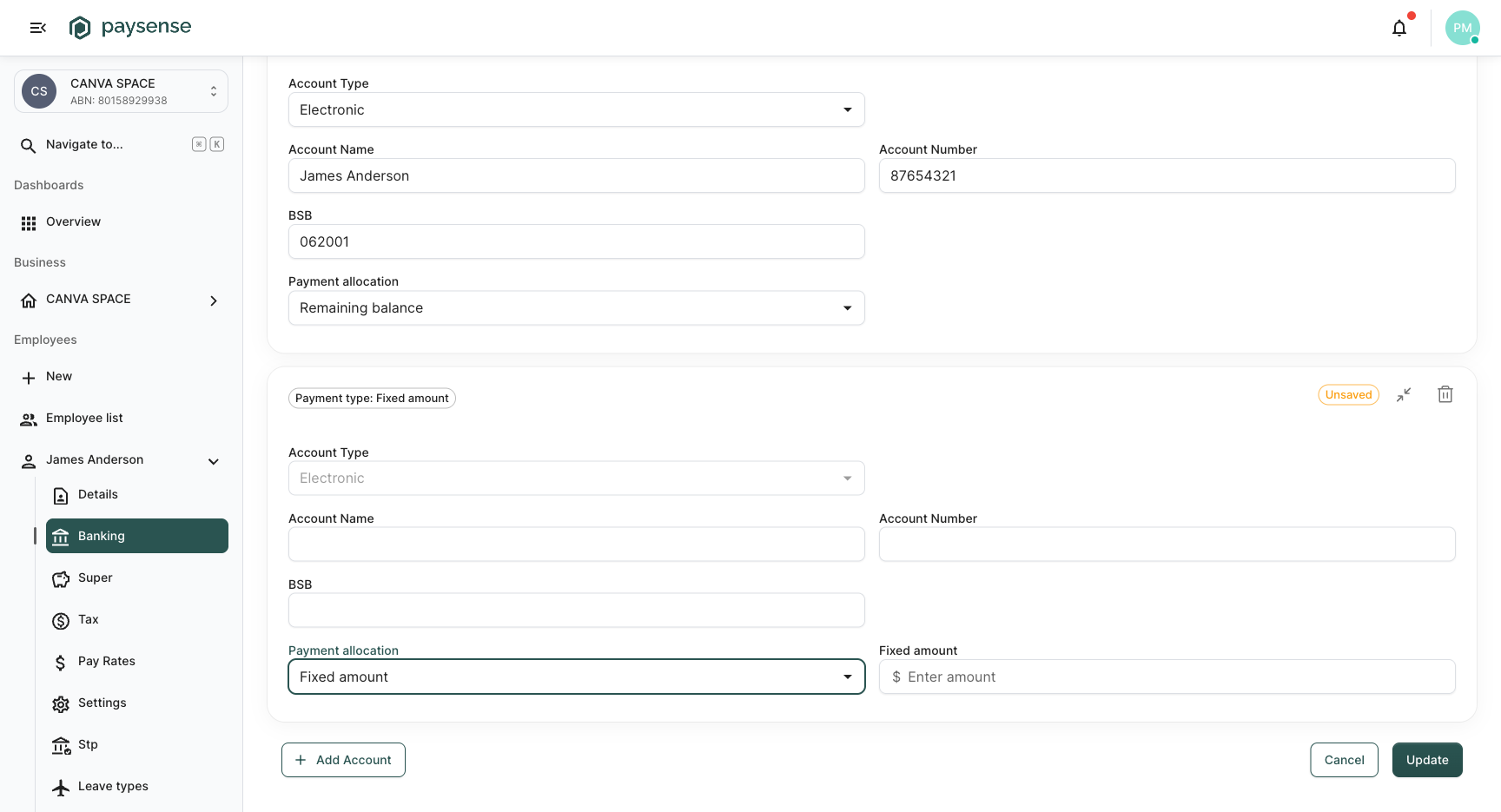
A common setup is to split pay between a savings account (fixed amount or percentage) and an everyday account (remaining balance). For example, $500 fixed to savings and the remaining balance to the everyday account.
Allocation rules
Paysense enforces these rules to ensure every dollar of net pay is accounted for:
- Entire balance can only be used when the employee has a single bank account
- Only one account can be set to Remaining balance: it acts as the catch-all for whatever is left
- Percentage allocations across all accounts cannot exceed 100%
- If you use Fixed amount or Percentage, at least one other account must be set to Remaining balance to receive the remainder
- Manual allocation requires that the other accounts already cover the full pay (via Entire balance, Remaining balance, or percentages totalling 100%)
- All accounts must be the same type: you cannot mix Electronic and Cash accounts
When percentages are applied, Paysense calculates amounts after any fixed allocations have been deducted. The Remaining balance account automatically absorbs any rounding differences to ensure the total matches the net pay exactly.
Adding more accounts
Click Add Account at the bottom of the page to add additional bank accounts. There is no limit to the number of accounts, but every dollar of net pay must be allocated: Paysense will validate the configuration when you click Update.
To remove an account, click the delete icon on its card.
What's next
- Add an employee: if you haven't completed the employee setup wizard yet
- Run a pay run: wages will be split across the employee's accounts according to the allocation rules you've configured